2026-04-01 [Case Study] CSI and ASRock Industrial Validate Standards-Based O-PASTM Systems Management Architecture
Introduction
Collaborative Systems Integration (CSI), in partnership with ASRock Industrial, both members of the OPAF (Open Process Automation Forum) and COPA (Coalition of Open Process Automation), successfully validated a standards-based systems management architecture aligned with the Open Group O-PAS™ Standard.
The joint effort demonstrates how Distributed Control Nodes (DCNs) can be securely discovered, provisioned, managed, and continuously monitored within an open, software-defined industrial ecosystem, enhancing interoperability, scalability, and lifecycle efficiency across modern process automation environments.
A key milestone of the initiative was the integration of the ASRock Industrial iEP-7020E with AiSMA (ASRock Industrial System Management Architecture), a Redfish® agent native lifecycle management framework, forming the DCN management foundation to enable O-PAS™ system management & orchestration functions.


Background: Advancing O-PAS™ Systems Management
O-PAS™ Standard promotes open, interoperable control architectures spanning:
- Control Application layers (OPA Function Block Applications & Services)
- Network infrastructure (OCF communications)
- Distributed computer, control nodes and I/O (ACPs, DCNs & DCNIOs)
- Multi-vendor hardware and software ecosystems
The objective of this project was to demonstrate a repeatable, standards-based model for managing distributed ACPs, DCNs and DCNIOs across heterogeneous operating systems and vendor environments.
The validation environment included:
- Distributed iEP-7020E Series DCNs
- Ubuntu 22.04, Ubuntu 24.04, RHEL 9 and Windows 10/11
- Firmware validation across versions 1.2.0 through 1.3.3
Numerous automated lifecycle workflows and playbooks
Challange: Scaling Distributed Control Nodes in Open Architectures
Prior to implementation, DCN lifecycle management required:
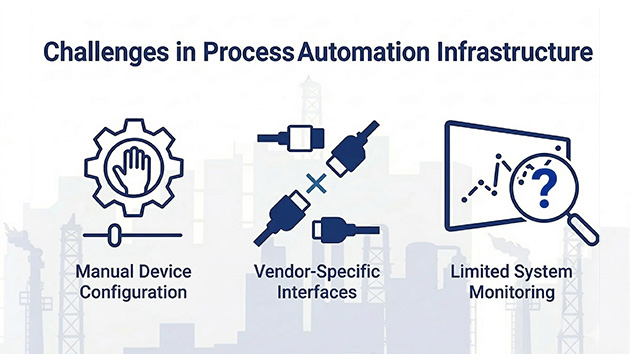
- Manual configuration steps
- Vendor-specific hardware interfaces
- Limited event-driven monitoring
- Inconsistent firmware state visibility
- Cross-platform validation across Linux distributions
Provisioning a single DCN requires manual setup, including device provisioning, network configuration, licensing, firmware validation, and event subscription configuration. Scaling this approach across multiple distributed nodes introduced operational overhead and configuration drift. For O-PAS™ environments spanning multiple vendors and software stacks, the manual approach does not scale well.
Solution: O-PAS™ CSI System Management & Orchestration with AiSMA
As illustrated in Figure 1, as the OPA ecosystems expand, scalable lifecycle management becomes crucial. CSI designed and validated a Systems Management & Orchestration architecture built around three core management functions:
- Discover — Hardware and software visibility
- Orchestrate — Provisioning and lifecycle control
- Monitor — Health and performance telemetry
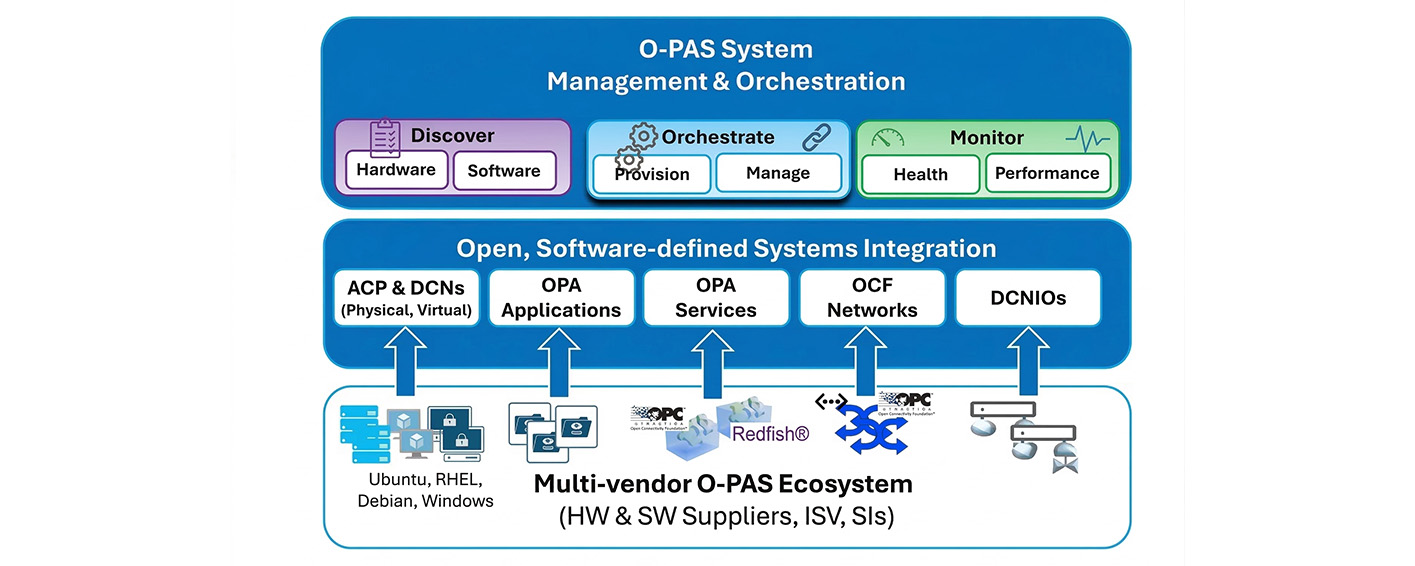
CSI integrated the ASRock Industrial iEP-7020E platform with AiSMA into the O-PAS™ Systems Management & Orchestration layer shown in the architectural model.
AiSMA provides a standardized Redfish®-based RESTful interface enabling:
- Hardware discovery
- Firmware identification
- Sensor visibility
- Account and network configuration auditing
Using Ansible-automated workflows, CSI implemented repeatable provisioning and lifecycle control processes across all deployed DCNs.
Results:
- Provisioning time was reduced per node
- A significant reduction in manual configuration effort
- Simultaneous automated configuration across multiple DCNs
- Elimination of manual license deployment steps
AiSMA’s Redfish® Event Service capabilities were validated and enhanced across firmware revisions 1.2.0 through 1.3.3, enabling:
- Real-time power and reset notifications
- Sensor threshold alerts
- Account and network state changes
- Firmware lifecycle notifications
Outbound events were validated using the DMTF Redfish® Event Listener and integrated into centralized observability systems.
Benefits: Enabling Open, Software-Defined Industrial Infrastructure
Along with other COPA partners’ production-grade products and continuous support, the joint CSI–ASRock Industrial collaboration effort demonstrated:
Operational Efficiency
- Reduction in DCN provisioning time
- Automated lifecycle control across distributed nodes
- Improved configuration consistency
Lifecycle Visibility
- Real-time event-driven monitoring
- Centralized firmware state validation
- Remote hardware management across heterogeneous OS platforms
Standards Alignment
- Hardware management using AiSMA
- Architecture aligned with O-PAS™ Part 5 Systems Management principles
- Scalable deployment model across multi-vendor ecosystems
This collaboration demonstrates how open standards, combined with industrial-grade hardware, can enable scalable, interoperable lifecycle management across modern O-PAS™ environments.
By integrating AiSMA, ASRock Industrial’s Redfish-based hardware management into the O-PAS™ Systems Management layer, CSI and ASRock Industrial have validated a repeatable model for scalable OPA Systems Management in today’s modern distributed control architectures.
Related Product